A Tone Circle™ is a guided group vocal toning practice where participants sit in a circle, and together with the practitioner, they tone simple vowel sounds and hum. The key is to sing in long sustained tones, followed by a long sustained breath. As the group tones together, a shared field of vibration and resonance is created that supports relaxation and nervous system regulation. No singing experience or musical background is needed. It’s less about hitting a note and more about letting sound move through you alongside everyone else in the room.
What Happens in a Tone Circle
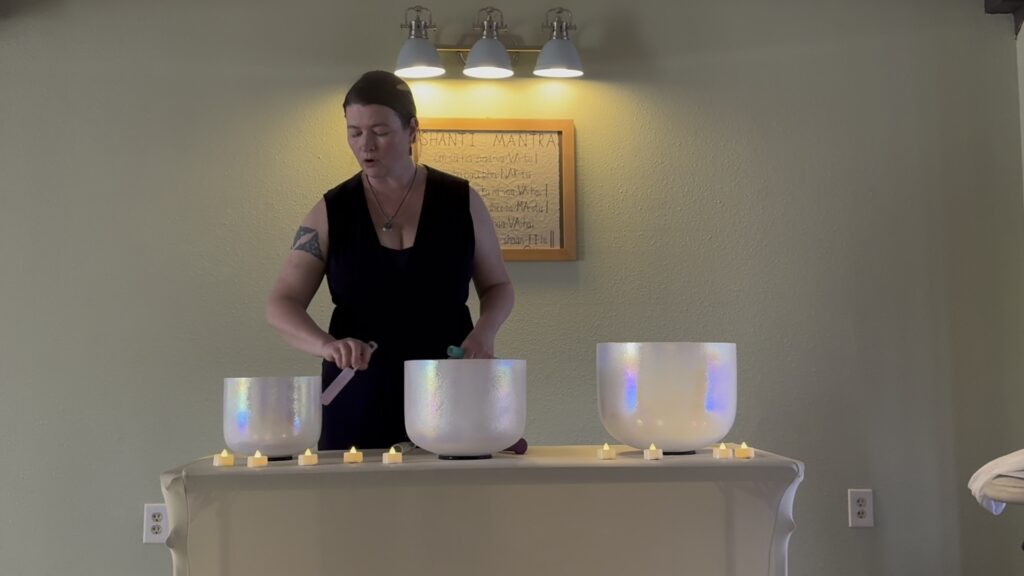
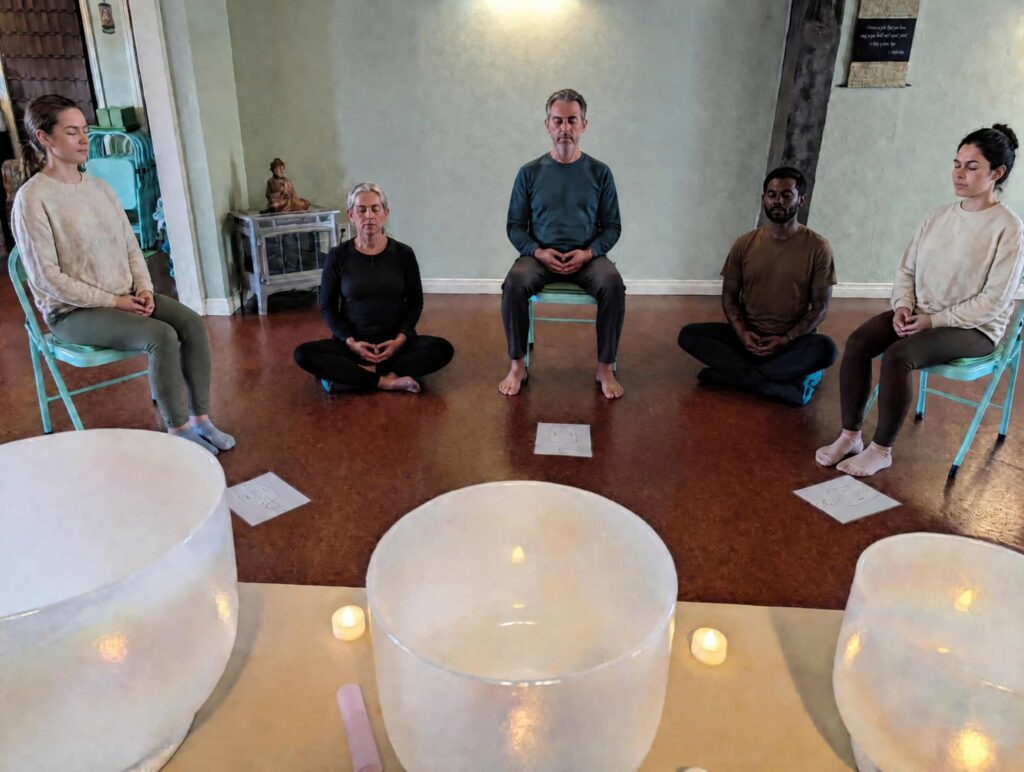
In a Tone Circle, we sit in a circle, with the practitioner leading the group as one member of that circle with their instruments of choice (I use crystal bowls) set up. There’s no stage, no audience, just a room full of people willing to make sound together.
Before we start toning together, I always go over some basics, including the vowel sounds we’ll use and what to expect during the session.
The vowel sounds are all sounds we already know, uh, ooo, oh, ah, eye, aye, eee. I also have laminated vowel sound cards displayed around the circle for anyone who wants something to look at while they settle in or a gentle reminder as we vocal tone together.
When the session begins, I start by playing the crystal bowls, then layer in toning on top of them, building the sound slowly rather than all at once. Some of my favorite vowel sounds to start with are “ah,” “oh,” and “ooo.” When toning, vowel sounds are held for long sustained tone, followed by a long sustained breath. This pattern helps create a coherence between our heart and mind, allowing us to drop into a more calm and relaxed state. Participants are welcome to join in whenever they feel ready, there’s no pressure to jump in right away.
As our bodies fall into coherence the room’s energy actually shifts, expanding outward into the collective group, where our voices build a shared resonant tone. Voices start to blend, and you can hear it happen, a kind of thickening in the sound as everyone settles into the same rhythm. By the end, most people are quieter inside than when they walked in, even though the room just got a lot louder.
The Science Behind It
Research backs up a lot of what people feel in a Tone Circle without being able to explain it. Singing requires slower, more controlled breathing than normal speech, and that breathing pattern directly affects heart activity through a mechanism called respiratory sinus arrhythmia, the natural rise and fall of heart rate that happens with each breath. A 2022 study found that singing paced at a slow, steady rhythm produced the same kind of beneficial heart rate variability increase as slow, controlled breathing on its own, meaning the voice itself can work as a tool for calming the nervous system, not just the breath behind it.
What’s especially relevant to a group setting: one study measuring heart rate variability across multiple singers found that coherence, the degree to which people’s heart rhythms sync up with each other, was measurably higher during group singing of a sustained mantra-like tone than during an unstructured condition.
Neuroacoustic researcher Dr. Jeffrey Thompson, who I’ve studied with, describes this as a kind of coupled oscillation, where a group of voices naturally finds a shared tone together, almost like individual nervous systems syncing into one. In plain terms, when a room full of people tones together, their bodies can start to physiologically entrain to each other, not just emotionally, but in actual heart rhythm. That’s close to the heart coherence I notice and describe when I lead a circle, there’s real research and expert observation suggesting it’s not just a feeling.
Why Group Toning Feels Different Than Toning Alone
Toning by yourself is powerful. I like to do it in the mornings, while I’m driving or walking, or any time I feel like I need to calm my body or quiet my mind. But something different happens when you’re toning in a room full of other people, and it’s not just the volume.
When a group vocal tones together, individual voices no longer stand out. What you hear is the collective voice, filled with overtones and layers. I like to think of it as a shared field, a kind of collective container that holds everyone in the room at once, built entirely out of breath, sound and vibration. You’re not just hearing your own voice anymore, you’re feeling the whole room’s.
This shared resonant field is why people come to Tone Circle gatherings, and often describe it as more emotionally moving than vocal toning on their own. If we take a step back and look at the bigger picture, when we tone together, we’re not just regulating our own nervous system, we’re doing it alongside other people who are doing the exact same thing, in the exact same moment, in the exact same room. Something very special is created when we share our voices this way, opening ourselves to a deeper connection and experience.
Frequently Asked Questions
Where to Join a Tone Circle
I am a certified Tone Circle facilitator and I currently host Tone Circle gatherings in La Conner, with Oak Harbor joining soon. Each location has its own schedule and details, so check the specific page for your area to see upcoming dates and registration.
- Tone Circle in La Conner
- Tone Circle in Oak Harbor (coming soon)
Results vary from person to person. Sound therapy is a complementary wellness practice. It does not diagnose or treat anxiety disorders and is not a substitute for medical or mental health care. It works powerfully alongside therapy, medication, and other evidence-based approaches.