Sound Healing Modalities Explained
Sound healing uses a range of instruments and vocal techniques to support relaxation and nervous system regulation, including Tibetan singing bowls, crystal singing bowls, tuning forks, solfeggio-tuned frequencies, and vocal toning. Other instruments, like didgeridoos and gongs, and even audio, are also used in sound healing. Each works a little differently, but they share a common foundation: using vibration, resonance and entrainment to help the body settle into a calmer state.
If you’ve never experienced sound healing therapy before, it can be hard to picture what actually happens in a session, since the word covers so much ground. The vibration of a Tibetan bowl placed on your chest feels nothing like a group sound bath filled with droning crystal bowls, and both feel completely different from a tuning fork combing through your bio field. Understanding what each sound tool is and how it works can make it easier to interpret sound experiences and how they might resonate with you.
I’m a certified sound healing practitioner serving Anacortes and the greater Skagit County area, and I’ve been working with clients for almost two years. Over that time, I’ve built a practice using a handful of sound healing instruments I trust and use regularly. Each bringing something different to my community events and private sessions. Below, I’ll walk through what each one actually is, how it works, and how I personally use it to navigate vibrational tuning.
My Sound Healing Instruments of Choice
1. Tibetan Singing Bowl Therapy
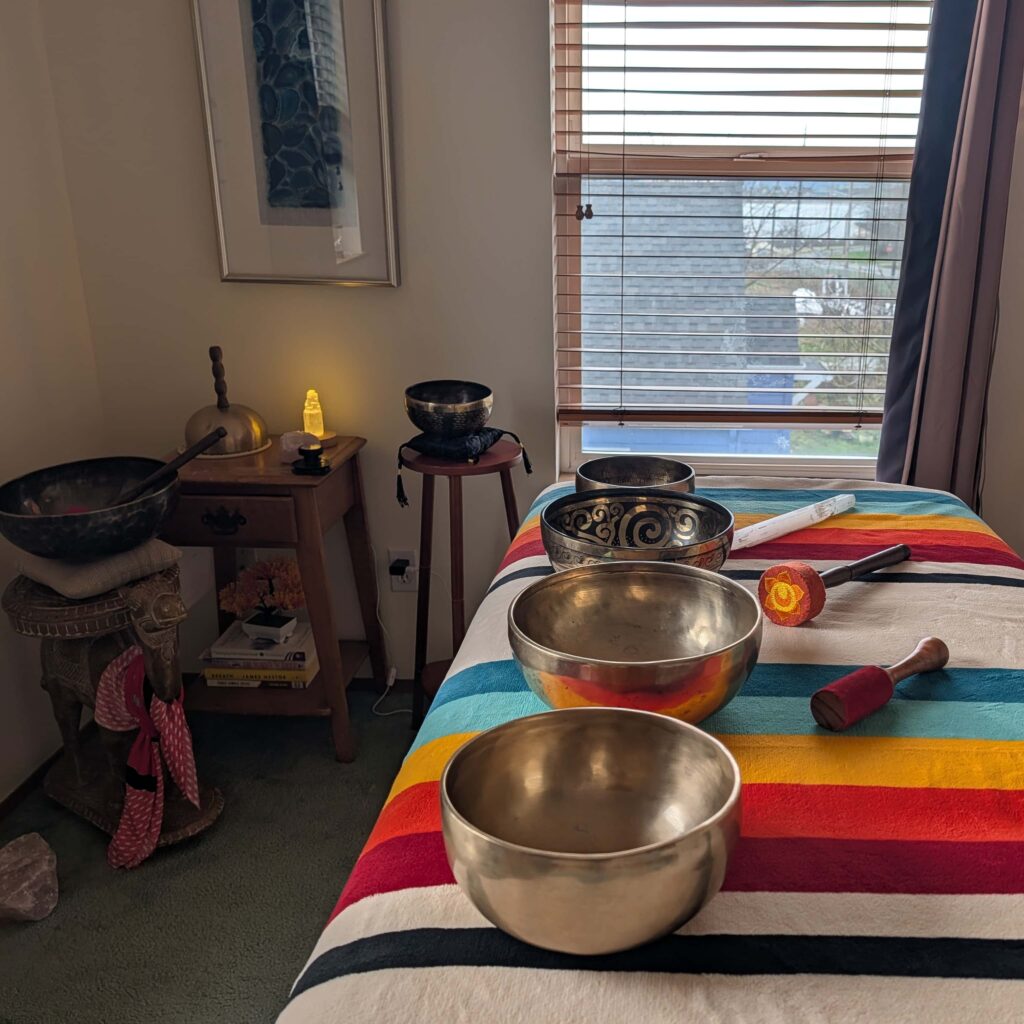
Tibetan singing bowls are the foundation of my sound healing private sessions, and my training here runs through Levels 1–3 Bowl Sound Therapy. Unlike a tuning fork or a solfeggio-tuned crystal bowl, Tibetan bowls aren’t built to a single precise frequency. Each one has a fundamental note and a complex layer of overtones, often somewhere in the range of 100 to 900 Hz, depending on its size and metal. This is what gives them that rich, textured sound rather than one clean tone.
For some of the people that come to see me, Tibetan singing bowls are the first real introduction to sound healing. During a private session, I place the bowls directly on and around the body so the vibration moves through and around you. When a bowl rests on your body, your body absorbs the frequency, with the intent for that part of you to fall into resonance with the bowl. I am also listening to the bowls to gauge what they are telling me about your body and biofield. What I hear, helps direct how I use the sound to create a more resonant state.
What you may not know is that I begin each session with a biofield assessment using pendulum. Then, as I move through the session, I listen to what the bowls tell me through their sounds. A spot that is out of balance rings differently. It may have an off tone, very little vibration, or both. When there is balance, the bowl will emit a deep resonant tone that has a strong vibration. One of my abilities is that I can easily read what the bowls are revealing about my client’s body and biofield. This shapes how I spend my time during a session, and how I can help you understand what you can do for yourself in between sessions.
2. Crystal Singing Bowls
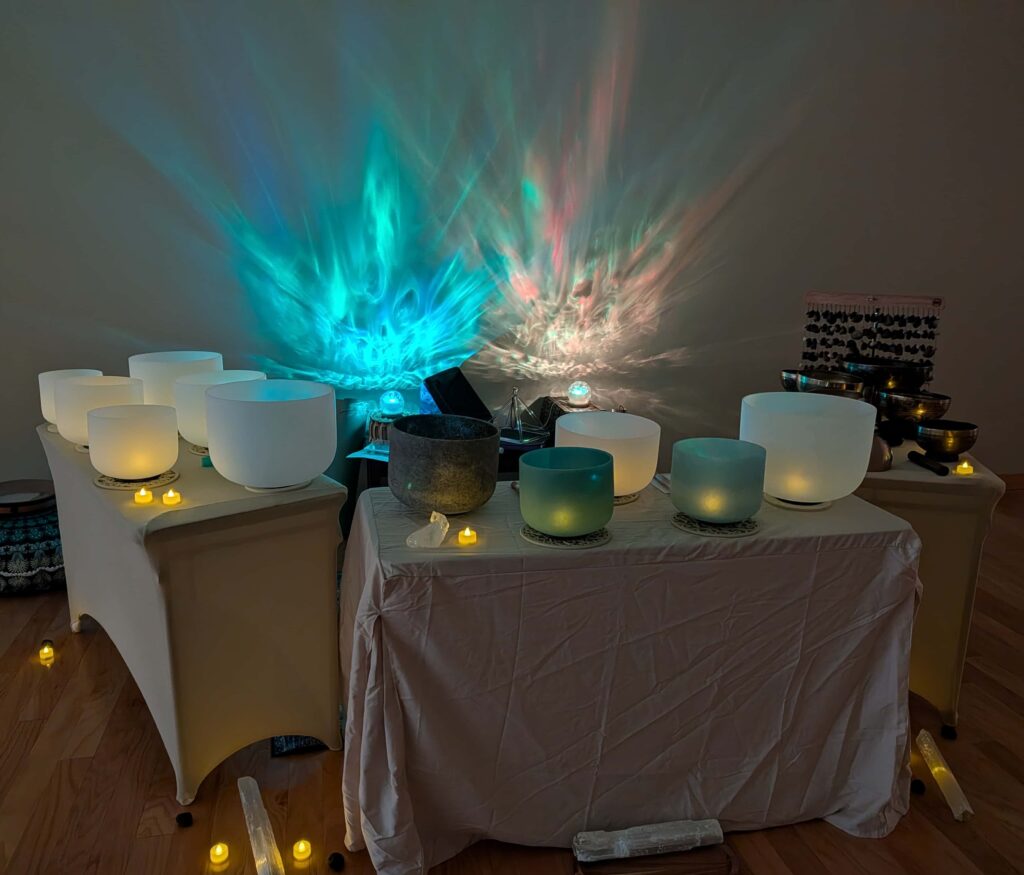
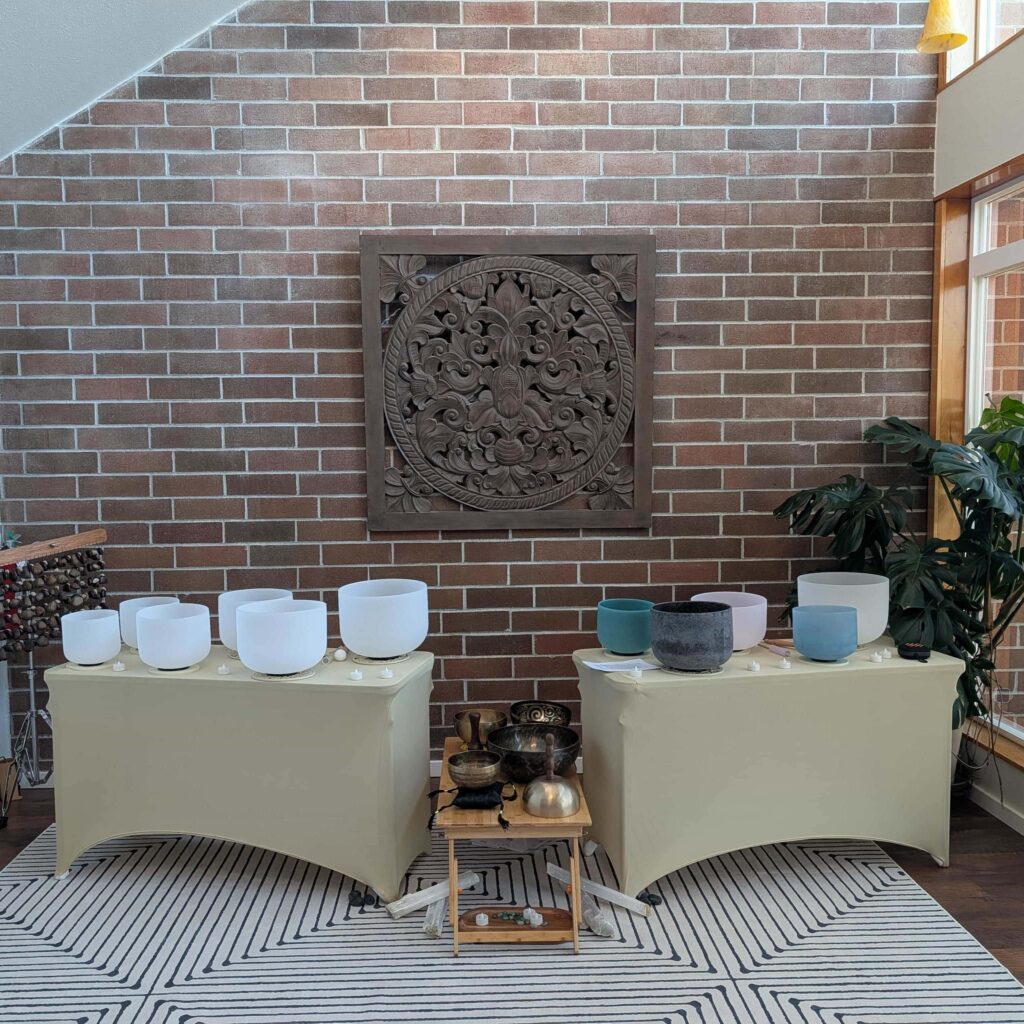
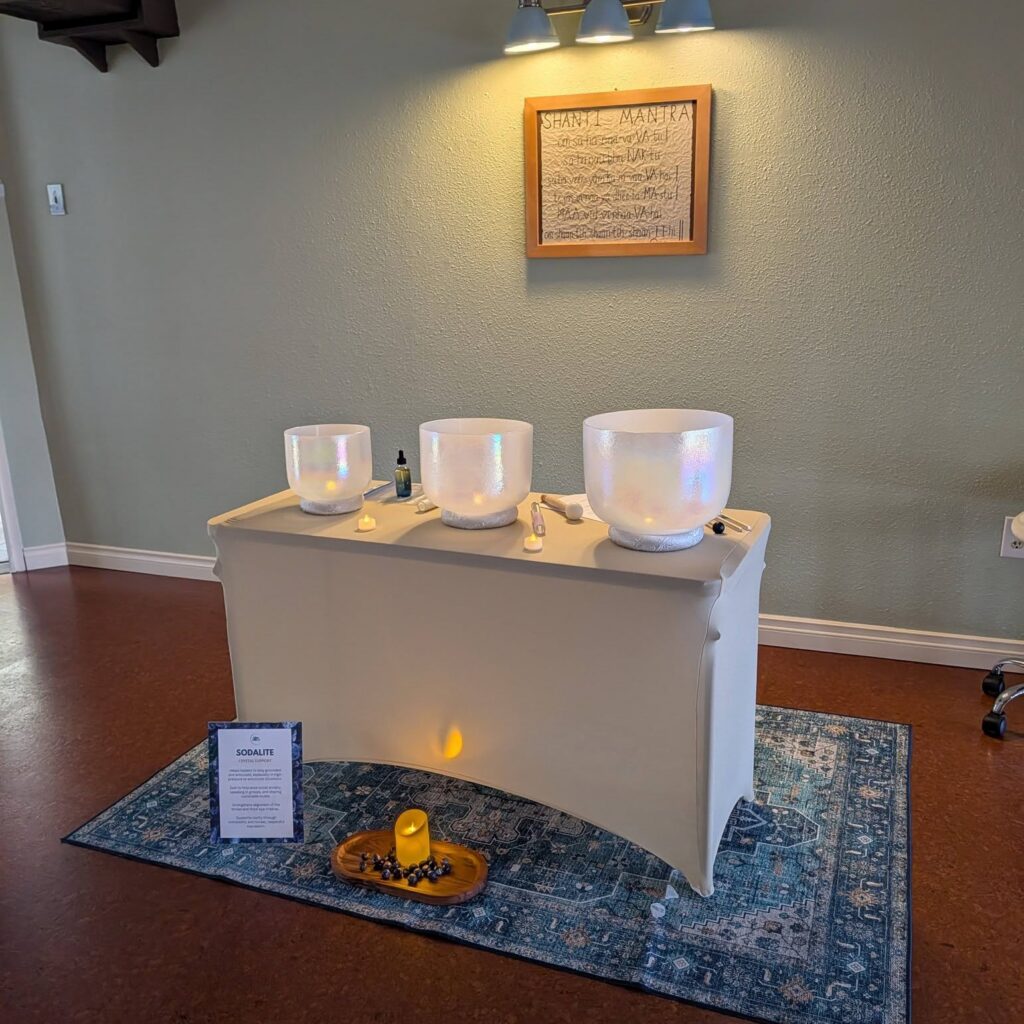
Crystal bowls are a new addition to sound healing, and were a byproduct of crystals grown in the labs for computers in t he 1980s. They produce a pure sine wave tone that moves through and around the body. In a sound bath setting they are very distinct from the layered overtones of a Tibetan bowl. Where a Tibetan bowl gives you texture, a crystal bowl gives you one clean, sustained note.
What most people fall in love with is the drone, a long, unbroken hum that seems to hang in the air and fill the room. That droning quality is also what makes crystal bowls so well-suited to group settings as the sound projects farther and holds longer than a Tibetan bowl, which is exactly why they’re central to my sound bath events. And, since their frequency goes through the body, it is often felt in the head, chest, and hips, providing an instant calming sensation.
During my sound baths, I work with two crystal bowl sets: a chakra-tuned set, built around the traditional note-per-chakra system, and a solfeggio-tuned set, ranging from 174 Hz to 852 Hz. Having both means I can shape a sound bath around either framework, depending on the feedback I receive from the bowls about what is needed that night. The solfeggio set in particular isn’t something you’ll find with most practitioners in this area.
3. Tuning Fork Therapy
Tuning forks come in two types, weighted and unweighted, and I use both for different purposes. Weighted forks are struck and then placed directly on the body, letting the vibration sink in and settle rather than pass through the air. Unweighted forks are struck and then combed through the biofield around the body, working with the field itself rather than the physical tissue.
During private sessions, I typically work with 417 Hz and 432 Hz, though I’ll bring in others depending on what a client shares with me and what the session calls for. Before the client arrives, I use 417 Hz to clear and cleanse the space, releasing any negative energy and inviting something more positive in. I also use the same frequency to help the client settle on the table before I do a chakra and biofield assessment.
I close the session with the 432 Hz fork to align the energy created during the session with the client’s current timeline and highest self. I also have other tuning forks, which I bring into a private session if a client’s needs call for that specific frequency work
Tuning forks are also part of my own personal practice. I use them as a bedtime ritual, rotating between forks and bowls depending on the night, to settle my own nervous system the same way I help settle my clients’.
4. Vibrapoint Sessions
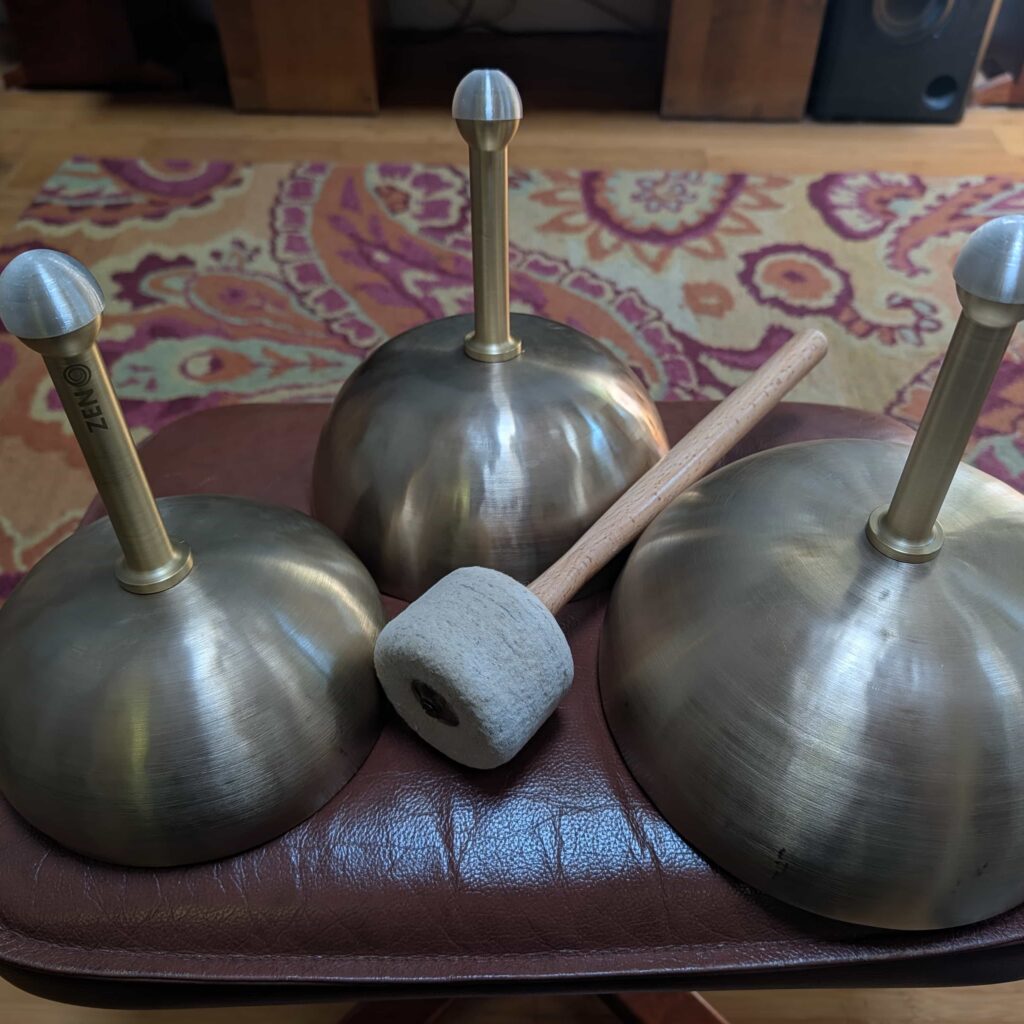
The Vibrapoint is the newest sound instrument in my collection. It is a metal bowl, with a metal handle, that is used to deliver targeted, precise vibration to specific points on the body. While it can also create vibrations for biofield work, it is a vibroacoustic therapy meant to be used on acupressure points. I hold a TheraVibes Vibrapoint Certification through the Vibrational Sound Association.
I’m currently completing my certification process. Once complete, Vibrapoint sessions will become part of my regular offerings.
5. Solfeggio Frequencies
Solfeggio frequencies are a set of specific tones, typically ranging from 174 Hz to 963 Hz, each historically associated with a different quality: grounding, release, renewal. The research on why they might affect us is still catching up to the tradition, but the felt experience people describe is consistent: a settling, a clearing, something shifting.
Solfeggio frequencies are actually where my own sound healing journey began. Long before I trained as a practitioner, I began listening to solfeggio frequencies in audio form and experienced some very profound shifts. That experience is what pulled me deeper into learning about sound healing, and eventually led me to purchase a solfeggio-tuned crystal bowl set of my own. I intentionally bring these frequencies into group sound baths through that bowl set.
6. Vocal Toning and Tone Circle™
Vocal toning uses your own voice as an instrument, sustaining a single tone or vowel sound until you can feel it vibrating in your chest and skull: no equipment, no cost, nothing between you and the sound. My foundation here comes from the Seattle Sound Temple’s Art of Sound Healing program, where I learned how to vocal tone, an approach well documented by sound healer Jonathan Goldman, and trained to vocal tone directly onto a client’s body using a system of sacred vowel sounds matched to each chakra.
Vocal toning shows up in many forms, from traditional chanting and seed mantra work to simple sacred vowel sounds like “ah,” “oh,” or “eee,” held for a long, sustained breath. I lean toward sacred vowel sounds in my own practice and in Tone Circle™, since they don’t require any particular language or belief system, nor memorized words. Anyone can drop into a vowel sound and feel it right away.
This practice became personal to me while I was recovering from two car accidents. Due to my injuries, I was finding it difficult to meditate like I had, between the pain and lack of focus. Toning helped me focus, reduced my pain, and calmed my nervous system, along with other benefits I felt along the way. That experience eventually led me to become a certified Tone Circle™ facilitator so I could bring the same practice to others in a group setting.
7. Other Instruments I Use
I use different instruments depending on whether a session is private or in a group. In sound baths, I often use the ocean drum, seed chimes and Koshi chimes. The ocean drum mimicks the sound of waves as a soft, rolling undertone, and seed chimes help mark transitions. In sound baths and private sessions, the magical notes of the Koshi chimes wrap up the experience.
Understanding the Biofield in Sound Work
The biofield refers to the subtle energy field said to surround and move through the body. The term itself was coined in 1992 by a National Institutes of Health committee seeking shared language to describe the organizing energy that some practitioners and researchers were exploring. Since then, researchers like biophysicist Dr. Beverly Rubik and UCLA scientist Dr. Valerie Hunt have studied and written about it, though it remains a debated concept in mainstream science. Eileen McKusick has spent years researching the biofield specifically through sound, and her certified method, Biofield Tuning, uses tuning forks to work directly with it.
I want to be upfront: I’m not certified in Biofield Tuning. What I have is a deep respect for Eileen’s research. I’ve also experienced the biofield myself, with myself and with clients, and that has shaped how I work with sound. In my private sessions, I’m listening to the bowls and the sound they make tells me where a client’s energy is stuck, empty, or frazzled. Usually that sound is an off-tone with little or no vibration. The sounds I hear guide how long I stay in one particular area.
How Does Sound Healing Work
People usually feel it before they can explain it. Sound can affect us in a variety of ways. Research suggests that sound helps shift the brain out of beta, the wide-awake, task-focused state most of us live in all day, and into theta and delta, the slower brainwave states associated with deep relaxation, dreaming sleep, and the body’s own repair processes. Our breath can slow, our muscles relax. Time can distort in a good way. This is something I’ve studied through a neuroacoustic workshop with Dr. Jeffrey Thompson, whose work looks closely at how rhythm and tone can help guide the nervous system toward a more balanced state.
Not everyone feels calm right away. Some people leave a session feeling activated, restless, or unexpectedly tired, something that Eileen describes as a kind of detox effect: the body processing and releasing whatever the session stirred up. Whatever you feel afterward is your body’s way of processing energy. It knows how to handle the frequencies it absorbed and will respond however it needs to. I always tell those I work with, if you’re feeling more tired or activated than expected after a session, to reach out as I have tips that help continue the release of energy from your body and biofield.
Results vary from person to person. Sound therapy is a complementary wellness practice. It does not diagnose or treat anxiety disorders and is not a substitute for medical or mental health care. It works powerfully alongside therapy, medication, and other evidence-based approaches.
Frequently Asked Questions:
Research suggests that certain frequencies help shift the brain out of beta, our normal wide-awake state, and into theta and delta, the slower brainwave states linked to deep relaxation and the body’s own repair processes. Related sound and vocal practices, like toning and chanting, have also been shown to increase heart rate variability, activate the vagus nerve, and lower cortisol, the body’s primary stress hormone. Dr. Mitchell Gaynor, an oncologist, saw similar calming effects using Tibetan bowls with his cancer patients. The body’s response to sound and vibration is well documented.
Typically, you lie down on a mat or blanket while instruments like Tibetan or crystal bowls and other musical instruments are played. Group sound baths usually run 45 to 75 minutes, with quiet time built in at the end before you ease back into the room.
My private sessions run 75 minutes and include a biofield assessment before the sound work begins.
The bowl is struck or played with a mallet, and the vibration travels through the air and through you directly when the bowl rests on your body. Your body absorbs the frequency, with the intent for that part of the body to fall into resonance with the bowl.
Sound healing is the umbrella term for the whole practice, and it can happen one-on-one or in a group. A sound bath is specifically a group experience, usually with crystal bowls, where you lie down and let the sound wash over you rather than being worked with individually. A private session is one-on-one: I work directly with your body, placing bowls on and around your body and biofield, tailoring the sound therapy you receive for your needs.