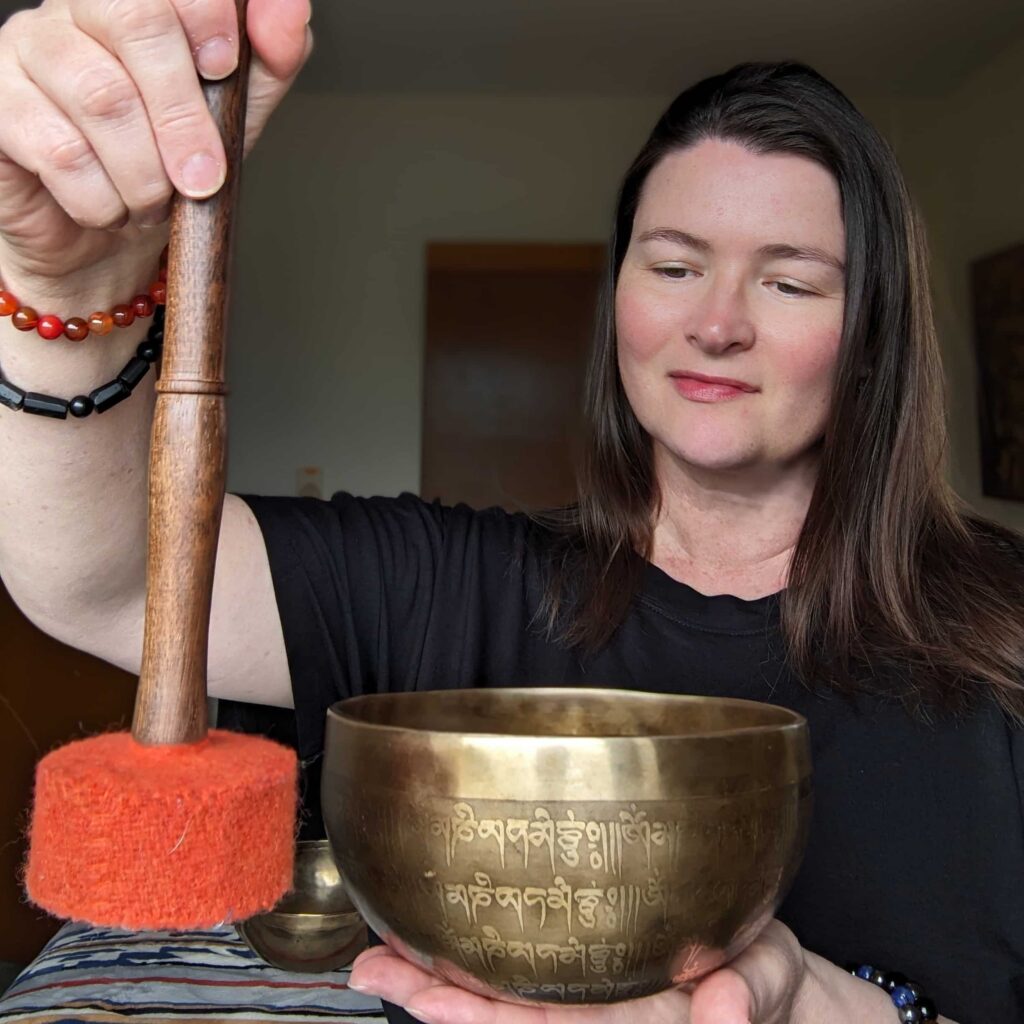
Sound Therapy for Anxiety
If worry or nervousness has been running the show, sound therapy for anxiety and stress relief may be what your body has been waiting for.
Book a Session → Learn how sound calms anxiety →
Sound healing sessions, sound baths, and workshops with Lara Dunning in Anacortes, WA.
Sound therapy for anxiety, also known as sound healing for anxiety, uses the vibration and resonance of live therapeutic instruments, including Tibetan singing bowls, crystal singing bowls, tuning forks, and vocal toning, to activate the parasympathetic nervous system, reduce cortisol, quiet limbic system activity, and guide the body out of a chronic anxiety or stress response.
Research supports measurable effects on the vagus nerve, heart rate variability (HRV), and brainwave states. Sound healing therapy is a gentle, non-invasive, complementary wellness practice that works alongside therapy, medication, and other approaches and modalities that support whole-body regulation and recovery.
When Sound Healing for Anxiety Works Where Other Approaches Don’t
Most people dealing with anxiety already know methods for dealing with their worries. They’ve talked through it. Or, have tried to rationally think their way out. And still, the body tightens, the shoulders never fully drop and the mind races at 2 am.
That’s because anxiety isn’t just a thought pattern. It’s a physiological state. When the body is locked in chronic anxiety or stress, the sympathetic nervous system, the branch responsible for the fight-or-flight response, stays activated long after the threat has passed. Cortisol and adrenaline remain elevated. The amygdala, the brain’s threat-detection center, stays on high alert. Sleep becomes difficult. Physical tension accumulates. And no amount of reasoning changes it, because the anxiety response is running below the level of conscious thought and our body’s frequency gets caught in an anxiety loop.
This is why so many people find that talk therapy and exercise as valuable as they are, often don’t fully reach the place where anxiety lives. The body needs something that works at the physiological level. Something that speaks directly to the nervous system.
Sound healing for anxiety works precisely because it operates at this physiological level, not by reasoning with the nervous system, but by giving it a frequency-based signal that it’s safe to release.
6 Ways Sound Therapy for Anxiety Calms Your Nervous System
Does sound therapy actual reduce anxiety? When I discovered the research behind what I was already experiencing in my own body when listening to frequencies, it changed everything about how I understood this work. Sound therapy works on anxiety through several documented physiological pathways:
1. Vagus nerve activation
The vagus nerve is the primary nerve of the parasympathetic nervous system, the body’s natural anxiety eraser. It governs heart rate, digestion, breathing, and emotional regulation. Sustained tones, through sound instruments like crystal singing bowls and Tibetan singing bowls, humming, and group vocal toning, directly stimulate the vagus nerve, signaling the body to downregulate its anxiety and stress response. Heart rate slows. Blood pressure drops. The body begins to settle in a way that feels almost immediate.
2. Cortisol & stress hormone reduction
Most of us know cortisol as the stress hormone; the one that keeps us wired, reactive, and unable to wind down. Research from Nepal Medical College found that five minutes of slow-paced humming induced measurable parasympathetic dominance in the cardiovascular system, significantly reducing both systolic and diastolic blood pressure. The same principle applies across sound healing modalities. When the body is immersed in sustained therapeutic frequencies, whether from a Tibetan singing bowl, a crystal bowl, or the human voice, the nervous system receives a clear signal to downregulate. A 2008 study from the Max Planck Institute took this further when 300 participants listened to 50 minutes of music, cortisol dropped and immune antibody levels rose simultaneously. A 2009 review of 23 studies covering nearly 1,500 patients confirmed that sound reduced heart rate, blood pressure, and anxiety in heart disease patients. As cortisol drops, oxytocin rises in its place. This hormone is associated with feeling safe, connected, and at ease.
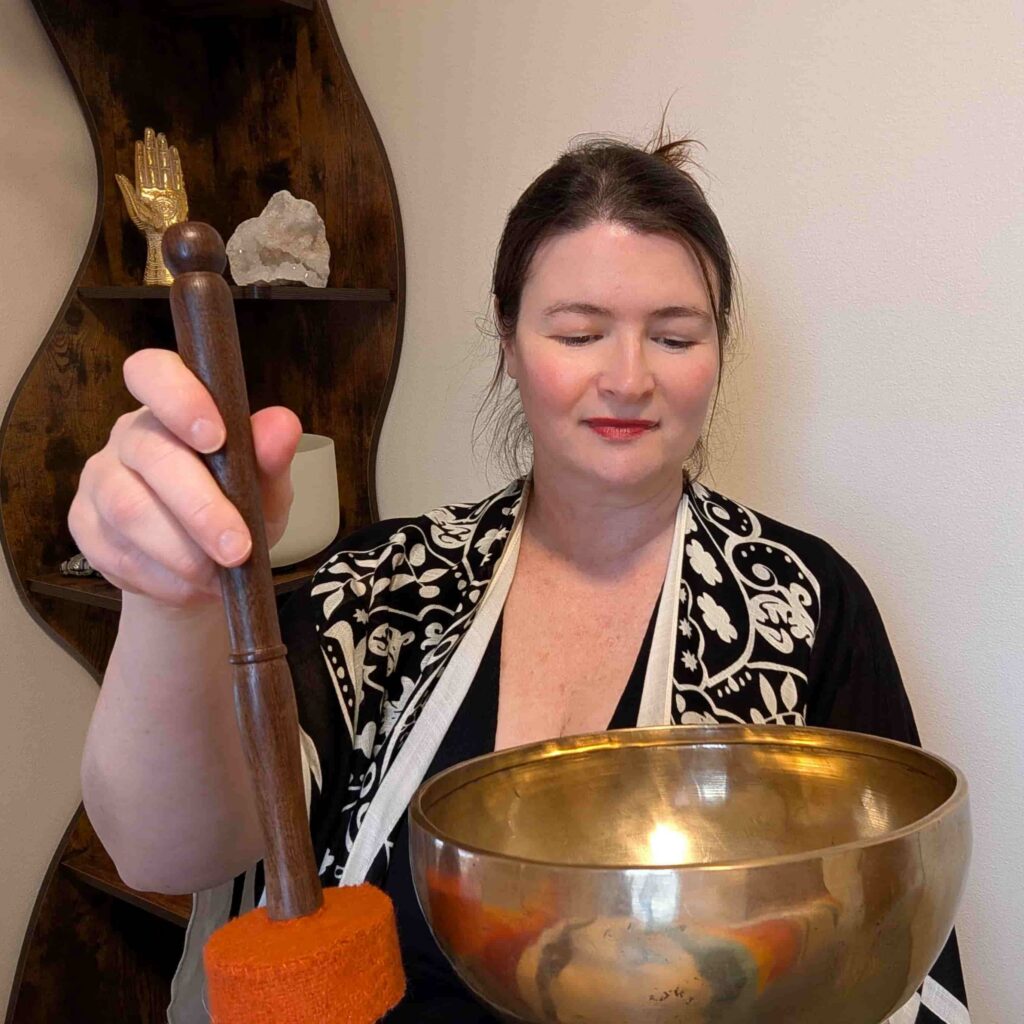
3. Limbic system deactivation
A 2011 study from the National Institute of Mental Health and Neuroscience in India found that sustained humming and OM chanting caused deactivation of the limbic system, which is the part of the brain that governs the fight-or-flight response and emotional reactivity. When the limbic system quiets, anxiety reduces significantly and calm becomes genuinely accessible. What struck me about this research is that the humming quality of the sound appeared to be the key factor. Not just any sound produced the same result.
4. Brainwave entrainment
Therapeutic sound guides brainwaves from the busy beta states we spend most of our day in toward the slower alpha and theta states associated with deep relaxation and restorative rest. This is one of the things clients tell me most often after their first session, that they reached a stillness they hadn’t been able to easily access. The sound carries them there when the mind is being too busy, overthinking and overdoing.
Different frequency ranges produce different brainwave responses. Delta frequencies (0.5 to 4 Hz) support deep healing and restoration. Theta frequencies (4 to 8 Hz) open access to emotional release and creativity. Alpha frequencies (8 to 12 Hz) encourage relaxed awareness and stress relief. Therapeutic sound instruments naturally guide the brain toward these slower, restorative frequency ranges.
5. Nitric oxide, melatonin & cellular health
This is where the research gets quietly remarkable. Vocal toning and humming increase oxygen in the cells, stimulate lymphatic circulation, and boost melatonin production, which is the hormone that governs sleep cycles and circadian rhythm. For people whose anxiety shows up most acutely at night, that melatonin connection matters.
John Beaulieu’s tuning fork research adds another layer to this. He found that therapeutic sound frequencies spike the body’s production of nitric oxide, a signaling molecule that supports vasodilation, immune function, and stress downregulation at the cellular level. Whether the source is a tuning fork, a crystal bowl, or your own voice, the body’s response to sustained therapeutic frequency includes this same nitric oxide release.
Research cited by Jonathan Goldman in Healing Sounds: The Power of Harmonics shows that sustained vocal toning can bring blood pressure and heart rate to levels comparable to pharmaceutical intervention through nothing more than a hum or a vowel sound held with intention.
6. Heart rate variability and heart coherence
Research from the HeartMath Institute shows that regulated, rhythmic sound supports heart rate variability (HRV), a key marker of nervous system resilience and anxiety tolerance, by synchronizing the heart, breath, and nervous system into a coherent state. Higher HRV is directly associated with greater emotional regulation and stress resilience.
What strikes me about the HRV research is how consistently it shows up across such different groups of people. Combat veterans with PTSD. Patients with chronic brain injury. People struggling with severe anxiety and emotional dysregulation. Improving HRV through therapeutic sound has shown meaningful benefits for all of them, less anxiety, greater emotional resilience, better regulation. If it works across that range of human experience, it’s doing something real.
Sound therapy is a complementary wellness practice. It does not diagnose or treat anxiety disorders and is not a substitute for medical or mental health care. It works powerfully alongside therapy, medication, and other evidence-based approaches.
Live Therapeutic Instruments vs. Recorded Sound: Why the Difference Matters
Binaural beats, nature sounds, and white/pink/brown noise can all support relaxation and for some people (I’m one of them!) they are genuinely helpful. But live therapeutic sound healing is a fundamentally different experience, for several reasons worth understanding.
Recorded sound is fixed. Live therapeutic instruments create a dynamic, responsive field of resonance that shifts in real time. In addition, the practitioner can also shift the frequencies based on what they observe in the individual. During Lara’s private sessions, she plays a Tibetan singing bowl near or on the body. The vibration is felt physically, not just heard. The body responds to that resonance at a cellular level in a way that headphone-delivered audio cannot replicate. Through the sound of the bowls, she can detect where the body is resisting and where it is falling into resonance.
Crystal singing bowls take this a step further. Unlike most instruments, crystal bowls produce a pure sine wave, which is the simplest, most fundamental form of sound, a single clean frequency with no harmonic distortion. Because of this purity, the sound travels through and around the body rather than simply reaching the ears, making it an ideal instrument for sound baths.
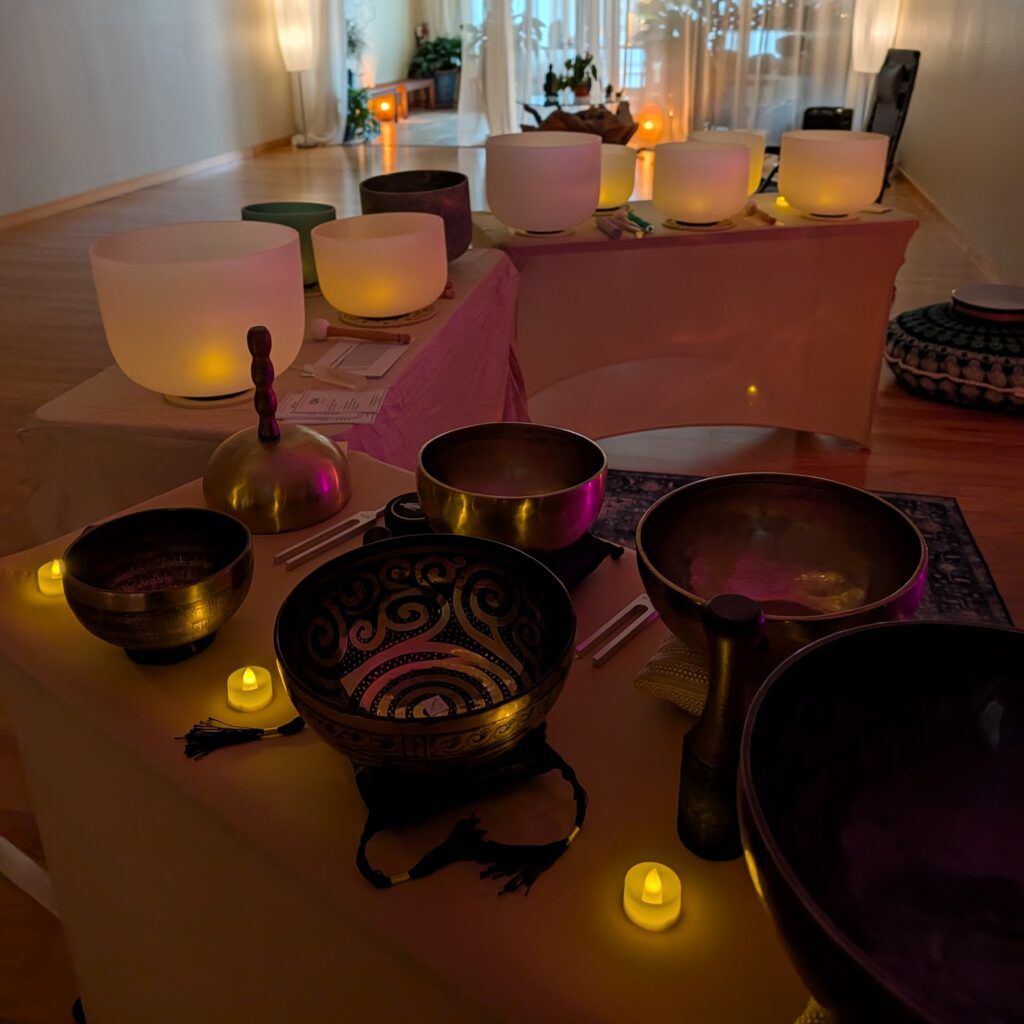
As an example, each crystal bowl in my Solfeggio-tuned crystal bowl set is calibrated to a specific Solfeggio frequency, an ancient system of tones with documented effects on the body and nervous system. 174 Hz eases pain and grounds physical tension. 396 Hz releases fear and restores emotional stability. 528 Hz supports cellular harmony and heart-centered calm. When these frequencies are delivered as pure sine waves through live crystal bowls rather than speakers, the body receives them at a depth that recorded audio simply cannot replicate.
Experiencing the physical frequency is why a live sound bath with crystal bowls produces a somatic experience that recorded sound, however high quality, cannot match. People often feel it in their chest, their hands, hips, or the top of their skull. You are not just hearing the sound. Your body is receiving it.
That being said, recorded sound definitely has its place, particularly for daily self-care between sessions. It’s how I started my own sound healing journey.
Lara’s Story: Why This Work is Personal
Lara Dunning came to sound therapy not as a practitioner first, but as someone who needed it.
After navigating her own journey through burnout, pain, anxiety, perimenopause symptoms, Lara understands firsthand what it means to feel trapped in a body that won’t settle; to know rationally that you’re safe, and yet feel anxious and unbalanced.
Sound was one of the things that reached her when other approaches hadn’t fully landed. That experience didn’t just shape her practice. It shaped her understanding of what her clients are carrying when they walk through the door.
When you work with Lara, you’re working with someone who has lived the experience of the stress and anxiety of overdoing, moved through it, and dedicated her practice to helping others find their way back to regulation, rest, and themselves.
Sound Healing for Anxiety Sessions With Lara in Anacortes
Lara offers several ways to experience the anxiety-relieving benefits of sound therapy in Anacortes and throughout the Skagit County area:
1. Private sound healing therapy sessions
A fully personalized, 75-minute one-on-one session designed around your specific needs, whether you’re carrying acute anxiety, chronic stress, burnout, perimenopause related symptoms or a combination. Includes a biofield and body assessment, a full sound healing sequence mainly using Tibetan singing bowls, but also use tuning forks and vocal toning. Afterwards, she provides clients with a written post-session recap within 24 hours that includes integration practices to carry forward.
This is Lara’s most targeted offering for anxiety and stress as it is personalized to you, responsive in real time, and followed by ongoing support.
2. Group sound baths
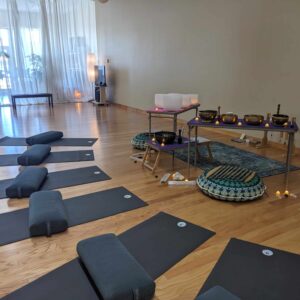
A shared experience of deep nervous system recovery. Participants lie down (fully clothed) while Lara plays live therapeutic instruments including her solfeggio frequency-tuned crystal singing bowl set, Tibetan bowls, ocean drums, and more. Deeply effective even for first-timers and those who find meditation difficult.
3. Vocal toning gatherings
There is something that happens when a group of people hum together that is genuinely hard to describe until you’ve felt it. Individual tones align, the room shifts, and a shared field of calm takes shape that is larger than any one person could create alone. Research published in peer-reviewed journals and cited by Harvard Health confirms that singing and toning reduce cortisol and cortisone, release endorphins and oxytocin, regulate heart rate variability, and provide a somatic pathway for releasing held emotions and stress. Led by Lara as a certified Tone Circle™ facilitator. No musical experience or singing ability required.
What clients experience after sound therapy for anxiety
People come to sound healing for anxiety relief for many different reasons like burnout, chronic worry, panic, sleeplessness, and emotional heaviness. What they commonly report afterward:
- A quieter mind: racing thoughts slow and mental space returns
- Physical release: tension in the shoulders, chest, neck, and jaw dissolves
- Deeper, more restful sleep: falling asleep more easily, staying asleep longer
- Emotional lightness: a sense that something heavy has been set down
- Greater resilience; feeling less reactive and more grounded in daily life
- Reduced rumination; the loop of anxious thinking becomes easier to step out of
Whether you come seeking sound therapy for stress relief, anxiety reduction, or simply a few hours of genuine rest, what most people find is the same thing, a body that finally remembers how to let go.
Results vary from person to person. Sound therapy is a complementary wellness practice and does not diagnose, treat, or cure any medical or psychological condition.